
Olafur Eliasson, Tunnel for unfolding time, 2022, Installation view: Fundación Hortensia Herrero, Valencia,Photo: Sharron Ping-Jen Lee / Studio Olafur Eliasson
Commissioned by: Fundación Hortensia Herrero, Valencia © 2022 Olafur Eliasson
June 2026
Dear Readers,
The three essays in this issue of The Art Section focus on living artists — Olafur Eliasson, Amy Sherald, and Michael David — whose work centers on perception, color, and emotional experience as core elements of their artistic practice.
Carol Senf has written about Amy Sherald’s exhibition American Sublime, currently on view at the High Museum of Art in Atlanta. Sherald’s monumental portraits possess a powerful psychological presence created through her use of flattened space and color, giving her subjects both gravity and dignity. Her use of grisaille, or grayscale, for the sitters’ skin tones challenges conventional ideas of color as a marker of race. Sherald is celebrated in Atlanta (as a homegirl) as she attended Clark Atlanta University, earning her bachelor’s degree in 1997. Concurrent with her studies there, she apprenticed with artist and historian Arturo Lindsay at Spelman College. Senf writes about these paintings with close attention to the authority they command, as well as their symbolic and conceptual dimensions. Her essay moves beyond representation to explore the political and psychological complexity embedded within Sherald’s portraits.
Michael David, who grew up in Brooklyn and spent many years in Atlanta, currently maintains a studio in Tivoli, New York. I invited Michaël Amy — Distinguished Professor of Art History at the Rochester Institute of Technology — to engage in a dialogue with David. The resulting conversation reveals the depth of David’s shattered mirror paintings, whose material surfaces exist between intuition and transcendence and evoke spiritual and emotional resonance.
Olafur Eliasson, an internationally recognized Icelandic-Danish artist, uses light, atmosphere, reflection, fog, and spatial immersion to heighten awareness of perception itself. Sara Buoso, an art historian based in Rome, Italy with a particular interest in artists working with light and color, considers Eliasson’s work in relation to the ways his installations challenge how viewers see and inhabit space.
It is important that The Art Section continues to foster dialogue around living artists while connecting readers to contemporary artistic practices that expand understanding of perception, materiality, and human experience.
Many thanks,
Deanna
Deanna Sirlin
Editor-in-Chief
The Art Section
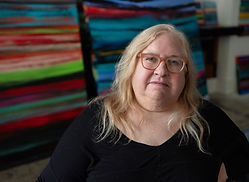
Deanna Sirlin is an artist and writer from Brooklyn, New York currently living and working in Georgia. She received an MFA from Queens College, CUNY where she studied with Robert Pincus-Witten, Charles Cajori and Benny Andrews. She has received numerous honors, including a Rothko Foundation Symposium Residency, a grant from the United States State Department, a Yaddo Foundation Residency and a Creative Capital Warhol Foundation Award for its Art Writing Mentorship Program. Her book She's Got What It Takes: American Women Artists in Dialogue was published by Charta Art Books, Milan, IT and New York City, NY
Deanna Sirlin
Photo: Jerry Siegel