
Rothko a Firenze, exhibition views, Palazzo Strozzi, Museo di San Marco, Biblioteca Medicea Laurenziana, Firenze, 2026. Photo Ela Bialkowska, OKNO Studio
After All, the Truth in Painting: Mark Rothko in Florence
by Sara Buoso

Rothko a Firenze, exhibition views, Palazzo Strozzi, Museo di San Marco, Biblioteca Medicea Laurenziana, Firenze, 2026.
Photo Ela Bialkowska, OKNO Studio

Mark Rothko 1952-1953 circa. Photo Henry Elkan / Courtesy The Rothko Family Archive
The major exhibition Mark Rothko in Florence is an homage to the American artist and to classicism. Retracing the path that Rothko followed when visiting Florence in 1950, 1959, and 1966, the exhibition at Palazzo Strozzi, curated by Christopher Rothko and Elena Geuna, includes satellite displays in the Convent of San Mark and the Biblioteca Laurenziana to reflect on the pictorial, plastic, and architectural dimension of the artist’s oeuvre. The exhibition is also an homage to the Renaissance light and beauty which palpably envelop the space where Mark Rothko entered into a dialogue with this legacy in an intimate and immanent dialectics.
Contemplating a painting by Mark Rothko explains why art is a privileged universal language transcending time. No words can fully grasp such an experience, not to mention that such experiences cannot be repeated. By the exhibition Mark Rothko a Firenze at Palazzo Strozzi, Florence honors Rothko’s oeuvre by establishing an ideal dialogue between the language of modernist abstraction and classicism, with reference to the Florentine Renaissance culture in particular. It is well known that Rothko visited Florence on several occasions - in 1950, 1959, and 1966 - and the exhibition at Palazzo Strozzi aims to retrace how these visits may have shaped and affected the artist’s vision until his very last paintings. In the words of Christopher Rothko - the artist’s son and curator of this major retrospective in conjunction with art historian and curator, Elena Geuna - the exhibition evokes a dream intended to reenact the paths Rothko may have followed and the traces he may have left in his exploration of Renaissance culture and context. To paraphrase the thinking of the classicist American art historian Bernard Berenson, very much admired by Rothko, classicism is the style that most superbly incarnates the capacity to figure solid and spatial forms; this capacity reflects an attempt to achieve an ideal order through harmonic proportions and equilibrium for the purpose of achieving immutable beauty and truth. With the aim of perpetuating this view, the exhibition Mark Rothko in Florence establishes a dialectic by projecting both interpretations and affinities into the 21st century.

Mark Rothko, Untitled, 1952-3, Oil on canvas, 9 feet 10 1/8 x 14 feet 6 3/16 inches, Guggenheim Bilbao Museoa,
© 1995 Kate Rothko Prizel and Christopher Rothko/Artists Rights Society (ARS), New York
At Palazzo Strozzi, the exhibition sets a dramatic tone. This reflects the artist’s essential pictorial posture which, since his early paintings from the 1930s, had always incarnated the spirit of tragedy, marking an inescapable aspect of the human condition. In his practice, Rothko refers to the classic literature of the tragedian Aeschylus and the philosophical thinking of Nietzsche. Drama is intrinsic to the artist’s approach to painting, which he intends as a deeply spiritual path that moves through passions, sacrifices, ecstasy, tensions, and contrasts in search of the flame, the light, the beauty, and the truth. This sensibility is suggested by the painting Interior, 1936, a figural scene set in a classical arcade surmounted by decorative patterns and infused with an intense burgundy palette on the upper level of the composition, a tone that prefigures the chaos of a Dionysian spirit in a perpetual battle with an Apollonian vision, a trope which will remain with Rothko up until his later works. But whilst his compositions reflect a sense of classicism, Rothko visualizes the tragedy of modernity through claustrophobic and anamorphic views of cityscapes in the late 1930s, often in contrast with a calm and delicate sense of beauty, as seen in a series of portraits of female figures. From 1944 to 1948, Rothko will embrace the methods derived from late surrealist movements, as suggested in the exhibition by a rare collection of watercolors on watercolor paper, the Untitled series, exploring floating compositions in search of rhythm whilst investigating an archetypal symbolism.
Rothko’s understanding of color is also dramatic, resulting in a sublime and highly empathetic experience. This is mostly visible in the series Multiforms, 1946-49, where the artist begins to experiment with color and composition as if these pictorial elements allow him to discover their autonomous, vivid and metamorphic power apart from figuration. In painting No. 1 (N. 18), 1948, organic and anamorphic masses repulse and attract each other on a chaotic floating surface. Eventually, Rothko will learn how to master these forms by encountering the language of abstraction, as seen in No.3/ N.13, 1949, which reveals his personal interpretation of a more geometrical order achieved through a composition of horizontal blocks embedded with color modulations that will soon lead him to the practice of color field painting.
The dramatic dimension of Rothko’s oeuvre creates tension and contrast; these elements allow him to transcend the real to evoke, color, light, beauty, and the truth in painting. Figuration, symbolism, and metamorphosis dissolve in his later series of large-scale paintings from 1951-58. In this series, Rothko shows a superior mastery of color and composition as if an event occurs within the space of the pictorial surface, an event that derives plastically from the intrinsic power of space, color, line, structure, light, shade, and rhythm, all resulting in a sensuous modulation of glazing techniques on the surface. In other words, in this series, Rothko shows his personal interpretation of the technique of color field painting without abandoning an ideal order learned from classicism.
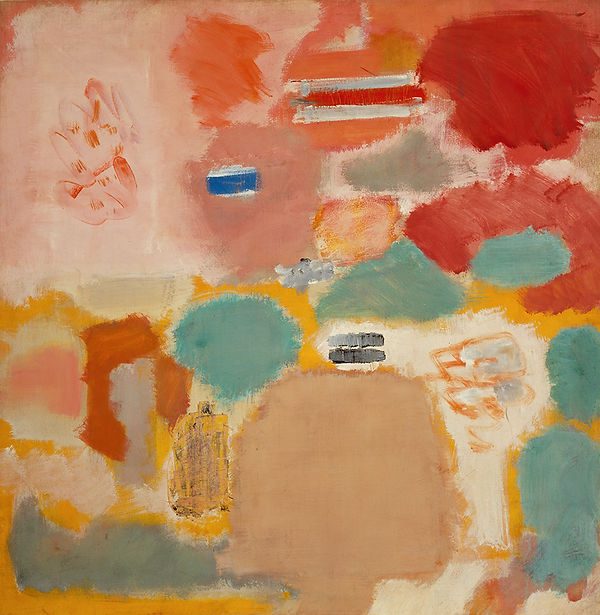
Mark Rothko, Untitled No. 21, 1947 , oil on canvas, 99.7 × 97.8 cm
Collection of Christopher Rothko © 1995 Kate Rothko Prizel and Christopher Rothko/Artists Rights Society (ARS), New York
At this stage, the exhibition sets the scene for an immersive landscape of meditative experiences by presenting a series of Rothko’s most classical paintings. The series of paintings No. 12, 1951, Untitled, 1952-53, Orange and Tan, 1954, No.13 (White Red on Yellow), 1958, theatrically creates a solar atmosphere in the gallery, modulating the luminous and warm shades of a red, yellow, orange, and white palette through a mature and confident sense of abstract composition. In a dramatic contrast, the series of paintings No. 2 (Blue, Red and Green), (Yellow, Red, Blue on Blue, 1953, Untitled, 1957, and Untitled, 1955, partakes of a blue, purple, and green palette, an homage to the landscape, to existence, to being, and in honor of light in the cosmos. As Rothko stated: “I suppose we have made such a contribution in the use of light and color…in relation to the seven points”: death, sensuality, tension, irony, play, ephemerality and chance, and hope (Address to Pratt Institute, 1958). To paraphrase the German impressionist artist Max Doerner, who strongly influenced the American Abstract Expressionists with The Materials of the Artist and Their Use in Painting, his major publication on the techniques of old masters published in German in 1921, and in English in 1934, it could be said that Rothko’s paintings reveal an inner light, a light that forms and informs the pictorial surface, as seen in deepening intermediate modulations and glazing on the surface. If this technique is typical of Abstract Expressionism, in Rothko’s practice it is also a reference to classicism. This can be justified by citing Bernard Berenson’s reading of tactile, rarefied, volumetric, and affective values of Florentine Renaissance painting.
In Rothko’s’ work, the very notion of pictorial field painting may also find references in classicism. Rothko’s interest in classical architecture from antiquity to the Renaissance is seen in the Seagram Murals of 1958–59, a series of paintings originally commissioned for the Four Seasons restaurant in Mies Van Der Rohe’s Seagram Building in New York City. During this commission, in 1959, Rothko and his family embarked on a grand tour to Europe and Italy. He first visited Paestum, Pompei, where he was fascinated by the deep, almost Dionysian, tone of burgundy used for the Pompeian frescos and where he realized how his practice was unconsciously influenced by the classical architecture of ancient temples. Rothko’s visit continued in Rome, Venice and Florence, where he was deeply fascinated by the plastic and architectural composition of Michelangelo Buonarroti for the Biblioteca Laurenziana. This encounter made an important contribution to Rothko’s investigation of the pictorial field and composition by allowing him to explore the metaphor of the window frame in painting. In citing Michelangelo’s architecture, Rothko rethinks the order of composition through a window which acts as a portal between two worlds, two realms, two spatial dimensions shaped plastically and perceptually. The Seagram Murals are represented in the exhibition by a series of rare works on paper, studies that show the choice of an intense burgundy palette marked by elusive brushstrokes that allude to a classical architectural order and powerfully connote a metaphor for a leap into the abyss. With this series of paintings conceived as an inseparable unity, the artist moves beyond the limit of the pictorial surface to constitute a place, a cave, a crypt for contemplation. The artist’s poetics have been preserved in the permanent display of these paintings in the Rothko room at TATE Modern in London.

Rothko a Firenze, exhibition views, Palazzo Strozzi, Museo di San Marco, Biblioteca Medicea Laurenziana, Firenze, 2026. Photo Ela Bialkowska, OKNO Studio
At Palazzo Strozzi, the exhibition takes a different path by introducing an atmosphere of noble simplicity and quiet grandeur in the pure spirit of classicism, as if in the late phase of his life, Rothko achieved the highest level of the mastery of pictorial composition. The perfect equilibrium of the series Untitled Black on Grey, 1969, evokes a sense of harmony and rigor achieved as an Apollonian vision through painting. In the same vein, the rare series of acrylics on paper, Untitled, 1969, often with a pure white margin left within the frames of the compositions, presents a sublime modulation of delicate, earthly, sandy, powder blue, and celestial tones. These are diaphanous works that show how ethereal Rothko’s pictorial vision became, allowing us to transcend our beings to encounter celestial light as a manifestation of the sacred.
In this view, Rothko’s painting is highly contemplative. The exhibition retraces the artist’s entire oeuvre by drawing on the solar, crepuscular and ethereal dimensions embedded within the surface of his paintings. In all these phases, the pictorial surface never stops revealing light. This phenomenon can be read through the ancient practice of photagogia, or the practice of evoking light, as formulated by the Neoplatonic philosopher Iamblichus (c. 245 BC – c. 325 BC) and further reinterpreted in the vision of the Neoplatonic philosopher Marsilio Ficino (1433-1499), founder of the Neoplatonic Academy at Villa medicea dei Carreggi in Florence in 1462 under the patronage of Cosimo de’ Medici, according to which light is what allows humans to transcend being and encounter the divine. This is reflected in beauty, the harmonic relationship between light and the divine order, and ideal proportions as a manifestation of the cosmic vision reflected in art and architecture.

Rothko a Firenze, exhibition views, Palazzo Strozzi, Museo di San Marco, Biblioteca Medicea Laurenziana, Firenze, 2026. Photo Ela Bialkowska, OKNO Studio
But the exhibition at Palazzo Strozzi is incomplete. It continues with two satellite projects in selected locations in Florence dear to the artist. During his visit in 1950, Rothko went to the Convent of San Marco in Florence, where he encountered the series of frescos from 1438 – 1445 by the Dominican monk Beato Angelico decorating the monks’ cells on the first floor. The biblical theme chosen by Angelico, along with the solitary, meditative, and mystic atmosphere of this architecture had a deep impact on Rothko, and the exhibition initiates an ideal dialogue between these artists, both reflecting on the sense of the sacred. The interest in transcending the material world through photosensivity and light to encounter the divine and the sacred is ultimately a practice pursued by both Angelico and Rothko in their respective art and lives. Through a superbly curated juxtaposition of both biblical and abstract works at the convent of San Marco, the exhibition responds to the site by modulating the delicate, celestial tones of the suffused light of the annunciation, the light of sacrifice, the light of the transfiguration of bodies, and of the non-representable sacred in an intimate and moving dialogue.

Rothko a Firenze, exhibition views, Palazzo Strozzi, Museo di San Marco, Biblioteca Medicea Laurenziana, Firenze, 2026. Photo Ela Bialkowska, OKNO Studio
Not far from the Convent of San Marco, the exhibition continues with a second dialogue, a dialogue between Rothko and Michelangelo Buonarroti at the Biblioteca Laurenziana, commissioned by Giulio dè Medici as a temple of knowledge and truth. When Rothko encountered Michelangelo’s major oeuvre in 1950, he was deeply fascinated by the vestibule and the unique staircase in the hall of the library because of its mannerist, dramatic tension, its chiaroscuro, its curvilinear and plastic effects that contrast with the proportions of a linear architecture. Rothko may have been interested in the metaphorical meaning of Michelangelo’s architecture: a plasticity that does not intend to serve decoration but rather acts perceptually; an architectural order split into two distinct registers, presenting a series of renaissance windows not intended to function structurally or aesthetically, but only as a frame. This interior, dramatic experience inspired Rothko’s research on the window frame in abstract painting for the Seagram Murals. The exhibition sets the scene for a dialogue between Michelangelo and Rothko by presenting two works in watercolor on paper. Seagram Mural Study, 1959, the first, is an homage to the window as a frame between two realms. The second piece is the frame of an antique sacred architecture suspended in an endless space and time. These, the final pieces presented in the exhibition, speak of the power of knowledge and truth in the arts.

Sara Bouso is an art critic and curator. She holds a PhD in Art Theory and History, Central Saint Martins, London, specializing in photology and practices of light. She is a lecturer in Contemporary Art History at AANT, Academy of Arts and New Technologies, and DAM, Digital Arts & Media Academy, Rome.
Sara Bouso