
Leonora Carrington, The Pleasures of Dagobert, 1945, Egg tempera on Masonite, 29 3/4 × 34 1/4 inches, Collection of Eduardo F. Costantini
© 2025 Estate of Leonora Carrington / Artists Rights Society (ARS), New York
February 2026
Dear Readers,
The Art Section is going into its nineteenth year – it is one of the oldest publications of its kind.
In this issue for February 2026, The Art Section presents the third edition of The Exquisite Corpse. This way of creating a collective artwork began as a game at a party of Surrealists in Paris over a century ago. In 1925-26 André Breton wrote that the game was first played at the residence of friends, an old house in Montparnasse at 54 rue du Château. Besides himself, he mentions Marcel Duhamel, Jacques Prévert, Yves Tanguy and Benjamin Péret as original participants. One artist began with the head, then folded the paper so that the next artist could not see it. The next artist added a torso, folded the paper, and a blind collaboration was born.
There are many wonderful iterations of the process; most recently, I was told that many Exquisite Corpses are in the exhibition Dreamworld: Surrealism at 100 currently on view at the Philadelphia Museum. I also have learned that “In the 1940s, composers John Cage, Virgil Thomson, Henry Cowell, and Lou Harrison, composed a set of pieces using this same process—writing a measure of music, with 1 or 2 additional notes (sources differ), folding it on the bar line then passing it to the next person. The pieces were later arranged by Robert Hughes and published as Party Pieces. In TAS, we have recreated this action digitally. Each artist sent their assigned body part via email; they were joined to other parts using Photoshop. The outcome is fourteen bodies representing the work of 42 artists, and they are indeed exquisite. This is a tradition of working collaboratively that TAS hopes to continue with artists from around the world.
I am very pleased to have connected noted Bram Stoker scholar Dr. Carol Senf with artist Tim Youd during his exhibition in the Schatten Library at Emory University in Atlanta. This exhibition and performance are part of Youd’s 100 Novels Project for which Youd retypes on a single sheet of paper an entire novel on the same kind of typewriter that the author originally used. I was so happy to be able to instigate the engaging dialogue between them for The Art Section. Senf wrote to me about connecting with Youd, that Stoker has his Mina character write about the wonders of the traveling typewriter that she takes with her, when she and the Crew of Light follow Dracula back to Transylvania.
Suzanne Jackson has made art for over six decades. Her roots are in San Francisco where a retrospective of her work, What is Love, is currently on view at SF MoMA. I like to think of Jackson as a Georgia artist, as she moved to Savannah in 1996 to take up a position as a Professor of Painting until she retired in 2009. In 2023, Jackson created a foundation in her home in Savannah for fully funded artists residencies; the first cohort was in 2025. Olivia Louise Marotte, who has written about Jackson for TAS, recently moved to San Francisco from Georgia herself. Marotte’s understanding and writing about the artist’s work is illuminated by her understanding of both places in the context of the artist’s oeuvre.
Sincerely,
Deanna
Deanna Sirlin
Editor-in-Chief
The Art Section
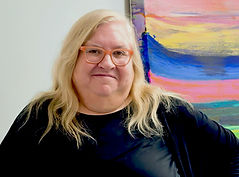
Deanna Sirlin is an artist and writer from Brooklyn, New York currently living and working in Georgia. She received an MFA from Queens College, CUNY where she studied with Robert Pincus-Witten, Charles Cajori and Benny Andrews. She has received numerous honors, including a Rothko Foundation Symposium Residency, a grant from the United States State Department, a Yaddo Foundation Residency and a Creative Capital Warhol Foundation Award for its Art Writing Mentorship Program. Her book She's Got What It Takes: American Women Artists in Dialogue was published by Charta Art Books, Milan, IT and New York City, NY
Deanna Sirlin
Photo: David Clifton-Strawn