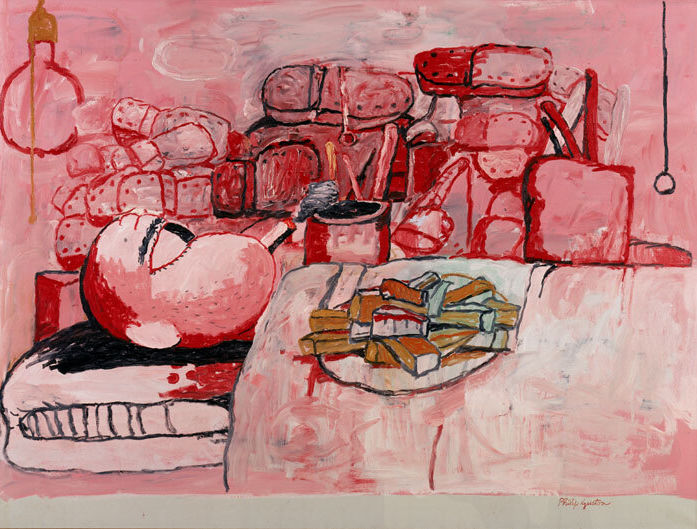
Philip Guston, Painting, Smoking, Eating, 1973, oil on canvas, 78 x 105 inches, Collection Stedelijk Museum Amsterdam, © Philip Guston via Hauser & Wirth Stedelijk Museum Amsterdam, verworven met steun van de Vereniging Rembrandt en mevr. Guston / Stedelijk Museum Amsterdam, acquired with the generous support of the Vereniging Rembrandt and Mrs. Guston
Poetic Lives of Pink
Curated by Nicolette Reim
The Poets
Edward Hirsch, Kathryn Kimball, Sean Nevin, Gail Mitchell and Ernest Gusella
The color pink isn't even real––it has to be mixed with another color to be seen. Its erratic history varies wildly within cultures––from symbolic of wealth and masculinity, including men who die on the battlefield in "the bloom of youth," to a feminine marker due to heavy commercial marketing of clothing. Now, it seems to be lifted from labels of cuteness, sweetness and innocence, and active in powerful roles, including politics.
Placed in the title, Hirsch's "pink," subtly unfolds via the poem's rhythm to an over-all tone that functions also as a ballast to the usual rough, aggressive movements associated with football. The idiom of pink, "the peak of health," adds to a positive, slightly magical, experience. Kimball barely mentions "pink" in her poem, but the word "baloney" screams the color. The meat's pigment adds comedy to the memory of a sandwich, and shows how "pink" contributes to the rose-colored glasses of nostalgia. Even the word "pink" with its short puff of sound, adds humor.
Nevin's "pink," is a joyful launch, a delightful, kitsch lawn ornament creates a metaphor as the poem builds to a crescendo of pink flamingos flying in the vee of geese––a flock of youthful pink hearts, innocent and transforming into or likened to the flamingos. Mitchell's poem describes a funeral casket covering, its exquisite and deeply felt stitched construction. The ekphrastic poetic form is also a tradition, joining with art, to become "the sister arts." The precious stones of the funeral piece, one pink––an unusual color in nature, add beauty and uniqueness to an African tradition.
Gusella's "pink" is a random pick, not deliberate. A wordsmith, Gusella sees words as stepping stones, an evolving path through associations, resulting in unexpected sentences. In a Dada-like manner, he might also have his lines collaborate with visuals and music. Though filled with humor and kitsch, the connections reveal deep concerns confronting us all. He sees "the purpose of art is meant to confuse. It's up to you."
Nicolette Reim
New York City, New York
August 2026
in the Pink
By Edward Hirsch
Coach Basrak wanted to find a school
where a freaky kid like me
could play football for four years
and discovered Grinnell College
in central Iowa, 1968, a haven
for gonzo jocks and oddballs
like Coach Bowers who walked
with a limp and said a college Receiver
should be like a ballet dancer
and so taught me how to turn
and twist, how to catch and toss
the flea flicker, the hook and ladder—
He got down in a three-point stance
and lifted me with a forearm shiver.
Edward Hirsch, a MacArthur Fellow, has published ten books of poems, including Gabriel: A Poem and Stranger by Night, and eight books of prose, most recently, The Heart of American Poetry and My Childhood in Pieces: A Stand-Up Comedy, a Skokie Elegy. He serves as president of the Guggenheim Foundation.
Baloney
By Kathryn Kimball
Grandma made sandwiches
with stuff I haven't eaten for years.
No tomato.
No lettuce.
Just two slices of
Wonder bread slathered with
Miracle Whip,
and one thin slab of pink—
hiding like a bunny's tongue.
I mean the baloney
made from unspecified body parts
from unspecified animals.
Could have been a bunny's tongue.
We kids smiled like the Kool-Aid picture,
happy with the fare
happy with the chipped plates
and the aluminum tumblers,
ice-cold and filled with sugar water.
We never minded the cockroaches either.
A slim brown thumbnail might take up
its lonesome journey across the table—
Grandma's only one, she said,
showing up only when company came around.
Now, a half century later,
when my memory no longer serves,
serve me up some of that real ersatz food.
It had pizzazz. That's no baloney.
Kathryn Kimball grew up in Montgomery, Alabama, has an MFA and PhD, and taught writing and nineteenth-century English literature. Her translations and poems have appeared in various literary journals. She published a chapbook in 2021 and a volume of poetry in 2025 and won the Columbia Journal 2023 translation prize.
Father’s Day Card
—For Amelia
By Sean Nevin
In the Middle Ages
Irish monks illuminated,
as a devotional practice,
the sacred manuscript
in the monastery at Kells.
You worked like this, too,
on my Father’s Day card,
alone, in the makeshift
scriptorium of your room.
And, like the monks,
you loved to color
in the empty fields
around the text
with the brilliant hues
of a rainbow arcing
above a nimbus cloud,
or a decorated initial—
ornate and gilded
as the yellow blossom
of a summer squash:
a volunteer rising up,
from the compost. Art
illuminates, like this,
the human spirit,
in the marginalia. Images
transcend words, the way
a Celtic knot will, weave
infinitely inward, without
beginning or end. Picture this,
a vee of wild flamingos
migrating across the page,
a flamboyance of pink hearts
drawn with the good magic
markers on the Hallmark
you picked out yourself,
at the pharmacy. Finally,
glistening at the bottom
of the card, your valediction—
“DAD, I 🖤 YOU”
in a still-tacky bead of glitter glue.
Sean Nevin is the author of Oblivio Gate which won the Crab Orchard Award Series First Book Prize. His honors include a Literature Fellowship in Poetry from the National Endowment for the Arts. His work was recently selected for Best American Poetry as Pick of the Week.
Covering
By Gail Mitchell
Bejeweled fingers
encircle the piece
like a child’s drawing
of two spread-feathered peafowls
facing each other.
Plumages quiver
as unfolding hands
show stitched nuggets
of amorphous amber
lapis lazuli
amethyst amulets
chatoyancy cat-eyes
pale pink rose quartz
black basanite jasper
unfurling in the textured vintage
as it covers her cloistered casket.
Gail Mitchell is a retired public-school teacher who has a masters’ degree in E.S.L. from West Chester University as well as an M.F.A. in Poetry from Drew University. She lives in central New Jersey.
I AM TICKLED PINK
BY ERNEST GUSELLA
I AM TICKLED PINK
BECAUSE I’M DRINKING FROM A SINK
A STRANGE ROSÉ CHAMPAGNE DRINK
THE FRENCH CALL ESPRESSO STINK
DID ANYBODY SEE ME WINK?
DID ANYBODY SEE ME WINK?
I AM TICKLED PINK
WHILE ICE SKATING ON A RINK
LEAVING LINES AND TRAILS OF INK
THE WHOLE PROCEDURE MAKES ME THINK
I MUST BE TEETERING ON THE BRINK
I MUST BE TEETERING ON THE BRINK
I AM TICKLED PINK
THE POLICE TOSSED ME IN A CLINK
I YAM, THEREFORE I ZINC
LIKE DARWIN’S MISSING EXTINCT LINK
IT’S TUTU MAURICE VLAMINK
IT’S TUTU MAURICE VLAMINK
I AM TICKLED PINK
LIKE BRITISH SINGER HUMPERDINK
WHO SAID EMANUEL KANT LIP-SYNC
JUST ASK CROWN PRINCE MAETERLINK
WON’T SOMEONE PLEASE CALL FOR SHRINK?
WON’T SOMEONE PLEASE CALL FOR SHRINK?
I AM TICKLED PINK
I MUST BE A LEFTY COMMIE FINK
BUCK NAKED UNDERNEATH MY MINK
BEFORE A FIGHT WITH LEON SPINKS
AND MOHAMMED ALI’S VERBAL JINKS
AND MOHAMMED ALI’S VERBAL JINKS
COPYRIGHT© MAY 23RD, 2026, CUMBERLAND, MD
Ernest Gusella studied classical music as a child and received a BA and MFA in painting from the San Francisco Art Institute. His collaborative avant garde experiences merge with extensive travel and time spent in other cultures. Honored by the National endowment of the Arts as well as a Guggenheim fellowship, he says, "My work is 1/4 California Funk, 1/4 NY PUNK, 1/4 Euro-peon Bunk and 1/4 Canadian Skunk.

Nicolette Reim studied art at The New York Studio School. She holds a master's degree in Poetry from Drew University. She exhibits at NohoM55 gallery, NYC, recent publications include the anthologies Border Lines, Poems of Migration, and Rumors, Secrets and Lies, Poems About Pregnancy, Abortion & Choice. She lives and works in NYC and Atlanta, Georgia.
Nicolette Reim