
Tina Modotti, Portrait of Edward Weston, 1924, Toned Gelatin Silver Print, 10 × 8 inches
The Art of the Hang: Photographers Who Shoot Artists
by Olivia Louise Marotte

Denis Piel, Portrait of Elaine and Willem de Kooning, 1983 © 2025 Denis Piel
Renowned American photographer Alfred Stieglitz began photographing his lover and then-nascent painter Georgia O’Keeffe in 1917. He would take over 300 photographs of her over the next twenty years. These photographs, which are deeply intimate and depict O’Keeffe’s hands, breasts, torso, and artistry in the studio in countless poses, attempt to capture O’Keeffe in her entirety. O’Keeffe wrote that Stieglitz’s “idea of a portrait was not just one picture,” but rather a kaleidoscopic collection of captured moments.
Stieglitz’s portraits of his muse are undeniably collaborative. An early photograph in Stieglitz’s vast collection of O’Keeffe portraits, from 1918, depicts the artist topless yet unexposed before one of her paintings. She wears a top hat that hides her hair, a choice that violated fashion norms for women of the early twentieth century. O’Keefe is an imposing presence, and her unfinished painting serves as an abstract floral backdrop. Quotidian intimacy is the key to the allure Stieglitz creates with his series of portraits. Each photograph exposes a fresh facet of O’Keeffe’s physical instincts, studio life, and sensuality.

Alfred Stieglitz, Georgia O'Keeffe, 1918, platinum print, 9½ x 7 5/8 inches
I find photographic portraits of artists compelling for their sense of intimacy and novelty, as did new photographers in the mid-nineteenth century. The creatively symbiotic dynamic between artist and photographer has existed as long as the camera. At first, artists and photographers wished to document the studio environment. As photography gained credibility as an art form, however, these images began to reflect the artist’s personality and process.
In the latter part of the twentieth century, editorial photographers experimented with their artist subjects, building on a foundation of their predecessors’ practices.
Veteran photographer Denis Piel has decades of experience shooting internationally for Vogue and Condé Nast. His approach to artist portraits shares Stieglitz’s kaleidoscopic, exploratory quality, especially when it comes to shooting female models. “My sittings are more like therapy sessions where I ask the sitter to reflect on different aspects of their life,” Piel shared of his process, “not verbally, but an interior emotional exploration.”
While Piel is known most widely for his fashion photography, in 1987, he photographed artist Jasper Johns, then in his late fifties, for Vogue. The results are true to Piel’s style: cinematic, intimate, and introspective. Despite the photographer’s flair for staged scenes, his fashion models exhibit unrestrained sensuality and autonomy. Johns’ poses are instinctive and undirected in Piel’s stripped-down, minimally lit studio as he touches his face and stretches the skin near his eyes with his hands.

Denis Piel, Portrait of Jasper Johns, 1987 © 2025 Denis Piel
In a departure from her editorial work for magazines such as Rolling Stone and Vanity Fair, photographer Annie Leibovitz captured Louise Bourgeois in New York in 1997. Her portrait evokes a visceral rawness similar to Piel’s portraits of Johns: late in age, her hair swept back to expose her profile, Bourgeois holds up her hand and gazes upon it. This gelatin silver print image appears materially and thematically unmanipulated.

Annie Leibovitz, Louise Bourgeois, New York, 1997, Gelatin silver print on paper, 29.2 x 40 cm, Collection Irish Museum of Modern Art,
Donated by the American Friends of the Arts in Ireland who received this work from David Kronn, 2014 ©Annie Leibovitz
Contemporary photographer and director Jason Schmidt has devoted a significant amount of his career to creating portraits of artists and cultural figures, and his books Artists (2007) and Artists II (2015) document these shoots. Schmidt has committed to photographing contemporary artists wherever in the world they produce their work. Whereas Piel and Leibovitz shot their artist subjects in more controlled environments, Schmidt insists on conveying the intimacy of the artist’s studio as if to offer the viewer a glimpse into their creative process. There is something voyeuristic about viewing Schmidt’s portraits, which are formally dynamic and exhibit Schmidt’s adaptability to his subjects’ environments. A 2007 portrait included in Artists II depicts the artist-provocateur Dash Snow mid-kiss with his lover, Jade, who nurses their newborn baby at an installation at Deitch Projects, NYC. None of the three is clothed. They are seated in a sea of shredded telephone books and paper, all part of an installation in New York called Nest (2007). Snow’s untimely death two years later only reinforces the ephemerality of Schmidt’s subject matter: contemporary artists and their environments are ever-changing.

Jason Schmidt, Dash Snow, August 7, 2007, New York, New York © Jason Schmidt
To further explore the contemporary photographer-artist relationship, I spoke with Atlanta-based photographers, Jerry Siegel and David Clifton-Strawn. Each has been drawn to photographing artists, and while their creative practices vary significantly, they are all adamant about the value of collaboration between an artist and a photographer in their artist portraiture.
Originally from Selma, Alabama, Jerry Siegel hesitates to call his photographic work his “practice.” Rather, he chooses to view his images as a natural product of informal hangouts with his friends, many of whom happen to be artists and creatives. Some of Siegel’s early work in artist portraiture features collected moments from time spent with his dear friend, the late Mary Ward Brown, a renowned writer from Alabama who also happened to be 41 years Siegel’s senior. Brown, along with a couple of older painters from around Selma, became his mentors and subjects. The group would gather and converse in Brown’s living room as Jerry snapped photographs every so often. “These were captured moments,” Jerry explained, “portraits, yes, but not in their studios. We were at Mary’s house, in her space, just spending time together.”
Mary Ward Brown introduced Siegel to Bill Eiland, a native Alabamian and the former director of the Georgia Museum of Art, who suggested to Siegel that he had the beginnings of a series devoted to portraits of late-career artists. Siegel developed a portfolio of these portraits, showcasing his ability to capture moments, not just people. Annette Cone Skelton, director of the Museum of Contemporary Art Georgia asked Siegel to participate in the museum’s Artists Photographing Artists exhibition in 2006. He compiled this body of work into a publication called Facing South, published in 2012. “It wasn’t like I set out to make a book,” Siegel explained to me. “I was just photographing these artists over the years: friends, introductions, people I admired… Over time, it grew to the point where Facing South just made sense. It was all there.”
During our conversation, Siegel and I often returned to “the art of the hang” to describe his creative process and source of inspiration. To produce a great photograph, not just a great portrait, he prioritizes finding common ground with his subjects and connecting at a personal level.
Siegel photographed the late artist and fellow Alabama native Thornton Dial at his home studio in Bessemer, Alabama in 2007. At the time, Dial was approaching 80 years of age. Dressed in an all-black outfit compromised by a few paint splatters, he stands formidably in front of the camera, making direct eye contact with Siegel’s lens. His expression is solemn. A self-taught artist, Dial’s use of found objects and paint in his works is abstractly conveyed in the background of Siegel’s portrait.
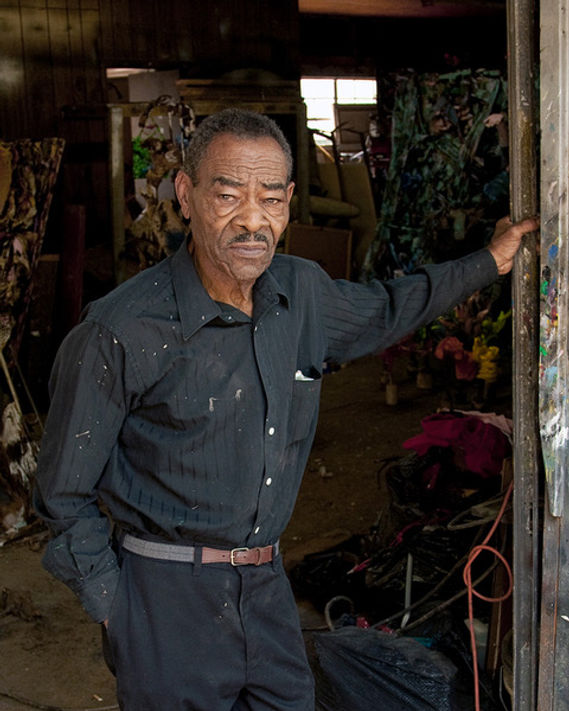
Jerry Siegel, Thornton Dial, McCalla, Alabama, 2007, 20 x 13.33 inches © Jerry Siegel
David Clifton-Strawn is another Atlanta-based artist whose portrait photography frequently presents his subjects in dignified classic poses in atmospheric chiaroscuro lighting. After being away from Atlanta for 20 years, Clifton-Strawn began photographing visual artists and performers to connect with communities and people he admired. As part of a larger interest in figure studies and portraiture, he recruited dancers and performers for their comfort in their bodies and in front of the camera.
Clifton-Strawn cultivates raw connection, then collaboration, with his subjects. I asked him how he establishes trust. “Creating that comfort starts with time. I’ll sit and chat with someone before putting them in front of the camera, especially if I’m using studio lights. All of that equipment can be intimidating,” he reflected. “I like asking people a lot of questions about themselves, and most people enjoy talking about themselves. While I’m photographing them, I’m learning as much as I can about who they are.”
Clifton-Strawn can usually find common ground with his models through their conversations during a shoot. I asked him how his subjects’ behaviors vary during shoots, to which he responded that entertainers and performers are typically more at ease in front of the camera, needing less direction, while visual artists may require more time to relax and become comfortable.
From 2019-2025, Clifton-Strawn assembled a collection of portraits called Atlanta Creatives, which he has shared in his book After a Long Intermission: Portraits from Atlanta’s Creative Community, published in 2025. The collection includes gallerists, arts administrators, writers, and artists alike, posing in the studio, their homes, studios, or sites they have agreed upon with Clifton-Strawn.

David Clifton-Strawn, Jeffrey Wilcox Paclipan, Multidisciplinary Artist, 2020,
Archival Pigment Print, 20 x 30 inches, Edition of 15 © 2025 by David Clifton-Strawn
Atlanta-based artist Jeffrey Wilcox Paclipan is a self-proclaimed alchemist, using found materials and paint to create new objects. Clifton-Strawn photographed him in his studio as a part of his Atlanta Creatives series. This portrait, in which Paclipan poses in a wide stance and grasps a sander, is reminiscent of Siegel’s portrait of Dial. Like Dial’s, Paclipan’s expression is sober but not severe as he offers us a glimpse into his studio, as if to tease, enter if you dare.
Enter we do, thanks to photographers who physically entwine themselves in the spaces where art is made, these places that are sacred and messy and private. But photographing artists remains a practice rooted in reciprocity. These portraits are never one-way acts of looking. They are negotiations between subject and photographer, between self-presentation and revelation.

Olivia Louise Marotte is a writer whose work centers on living artists and transnational modernism. A recent graduate of Swarthmore College, she wrote her thesis on Singaporean modern art after a semester of study in Singapore. She was a research assistant for Rosine 2.0, a socially engaged art project exploring harm reduction and healing in Philadelphia and has presented her work at national conferences. She currently lives in San Francisco, California.
Olivia Louise Marotte